
What is a Maternity Pillow? Everything You Need to Know
A maternity pillow is one of the most useful purchases you can make during pregnancy. Here's what it actually is, what it does, and how to choose the right one for your body and your bed.

A maternity pillow — also called a pregnancy pillow — is a purpose-designed support pillow for use during pregnancy. Unlike a regular pillow, which is designed to support your head and neck while sleeping, a maternity pillow is shaped and sized to support your body as it changes across the trimesters, with a specific focus on the areas that drive pregnancy sleep discomfort: your growing bump, your hips, and your lower back.
If you have never heard of one before, that is entirely normal. Maternity pillows are one of those products that most people don't know they need until they're lying awake at 3am with hip pain and a search engine open.
This guide covers what a maternity pillow is, what it does, the different types available, and how to choose the right one for you.
Why a regular pillow isn't enough
Before getting into types, it's worth understanding why a regular pillow doesn't solve the problem.
From around 18 to 20 weeks of pregnancy, side sleeping becomes the recommended and most comfortable sleeping position. But side sleeping without adequate support creates three specific problems simultaneously. The weight of your growing bump pulls downward on your lower back when you lie on your side, creating tension that builds through the night. Your top hip drops forward under gravity, rotating your pelvis and creating the hip pain that wakes most pregnant women in the early hours. And with nothing behind you, rolling onto your back is easy — which matters from 28 weeks when NSW Health recommends settling to sleep on your side.
A regular pillow can address one of these at a time. Put it between your knees and your hips feel better but your bump is still unsupported. Put it under your bump and your back feels better but your hips drop. Stack multiple regular pillows and they compress and shift during the night until the support is largely gone by 2am.
A maternity pillow is designed to address these problems more completely, more stably, and more comfortably than improvised regular pillow arrangements.
What a maternity pillow does
A well-designed maternity pillow does three things.
It supports your bump from below, providing lift that reduces the downward pull on your lower back when you lie on your side. It creates support between your knees that keeps your hips stacked in a neutral, aligned position rather than allowing the top hip to drop forward. And it provides something behind your lower back that discourages rolling and gives your body something to rest against slightly, reducing the muscular effort of maintaining a side-lying position through the night.
When all three areas are supported, side sleeping becomes genuinely comfortable rather than something your body is working against. The result is fewer overnight wakings, less pain, and better quality sleep across the second and third trimesters.
The different types of maternity pillow
Maternity pillows come in several distinct designs, each with different trade-offs around support, bed space, and versatility.
Wedge pillows
The smallest and most affordable type. A wedge is a triangular foam or firm cushion that can be positioned under the bump for lift, or behind the lower back for rolling prevention. Wedges are compact, inexpensive, and targeted. They are a good entry point for early pregnancy or for women who only need support in one specific area.
The limitation is that a single wedge addresses one zone at a time. Two wedges — one under the bump, one behind the back — cover more ground but don't provide knee support unless a separate pillow is added.
C-shaped body pillows
A long, curved pillow that wraps along your front, supporting your head, bump, and knees with one continuous piece. More comprehensive than a wedge and widely available at Australian baby retailers.
The trade-offs are heat retention, moderate bed space, and the need to carry the whole pillow with you when you roll from one side to the other. They don't support your back unless you add a separate pillow.
U-shaped full body pillows
The largest type. A U-shaped pillow wraps around both sides of your body, supporting your front and back simultaneously. The advantage is that you don't need to reposition the pillow when you roll — you simply move within it.
The trade-offs are significant. A U-shaped pillow is large enough to take up a substantial portion of a standard double or queen bed, which creates genuine problems in a shared bed. It retains heat considerably, which matters given that pregnancy already raises your core body temperature. And it is the most expensive option in the category.
Modular and adjustable systems
A newer design approach that uses multiple independent components rather than one large shape. Each component addresses one zone of support specifically — a front wedge under the bump, a piece between the knees, and a back wedge behind the lower back. Because each piece is positioned where it is actually needed, the support is more targeted and more stable than a single large pillow.
Modular systems take up considerably less bed space than U-shaped or C-shaped pillows because the components sit within your natural sleeping area rather than extending across the bed. They also stay in place better during position changes because each piece is small and independently positioned.
What to look for when buying a maternity pillow in Australia
Firmness. This is the most overlooked factor and one of the most important. A pillow that compresses under your body weight within the first hour provides very little meaningful support for the rest of the night. Look for firm, dense filling that holds its shape. Memory foam and high-density polyester maintain their position better than soft, low-density alternatives.
Cover material. You're spending a significant amount of time in contact with this pillow, often through the warmest months of pregnancy. A breathable, washable cover makes a real difference to sleep comfort. Organic cotton covers are the most breathable option and are particularly useful for women who sleep hot during pregnancy.
Size and bed footprint. If you share a bed, consider how much space the pillow will occupy. A compact modular system or wedge takes up a fraction of the space of a U-shaped pillow. Getting adequate support without creating friction in a shared bed is a real consideration worth factoring in before you buy.
Washability. Pregnancy involves a lot of sweating, and pillows need to be washed regularly. Confirm the cover is machine washable and that the filling either dries quickly or can also be washed. A pillow you can't easily clean becomes a hygiene issue over months of nightly use.
Postpartum versatility. A maternity pillow used from 20 weeks of pregnancy through several months of postpartum recovery represents considerably better value than one used only for the final trimester. Look for a pillow that has genuine postpartum use cases — feeding support, recovery rest, and general sleep comfort — rather than one that becomes redundant the day your baby arrives.
The Bumpnest Maternity Pillow
The Bumpnest Maternity Pillow is a three-piece modular system designed specifically around the three zones of support that pregnancy sleep requires. The front wedge supports under the bump, the auxiliary piece sits between the knees, and the back wedge sits behind the lower back. Each component is independently positioned, which means it stays in place when you roll rather than shifting as one large piece.
It is the only adjustable three-piece maternity pillow in Australia with an organic cotton cover — a meaningful difference for women who sleep hot during pregnancy. At $114, it is also the most affordable option in the adjustable modular category in Australia.
There is a 50-night trial. If it doesn't genuinely improve your sleep, return it.
See the Bumpnest Maternity Pillow →
When to buy a maternity pillow
The most useful window is around 18 to 22 weeks, when the bump begins to affect comfortable side lying but before discomfort has become significant. Starting at this point means your body adapts to the support setup before the third trimester, when sleep is most disrupted and adjusting to something new is harder.
That said, it is never too late to start. A maternity pillow purchased at 35 weeks still meaningfully improves the sleep quality of the final weeks of pregnancy and the postpartum period that follows.
Frequently asked questions
 Sleep
Sleep
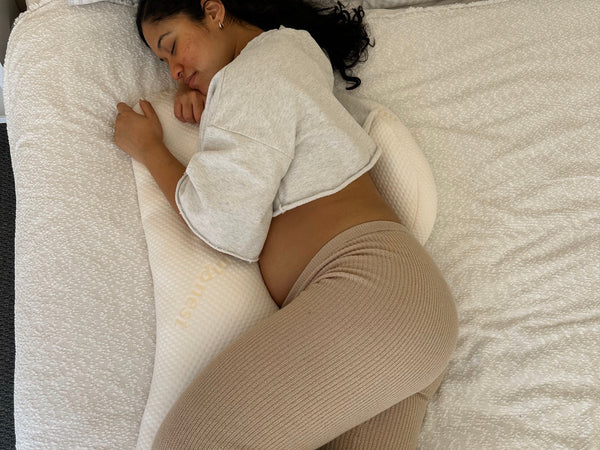
Pregnancy Pillow for Back Pain: What Actually Works
Pregnancy back pain at night is one of the most common sleep disruptors from the second trimester...
Read article →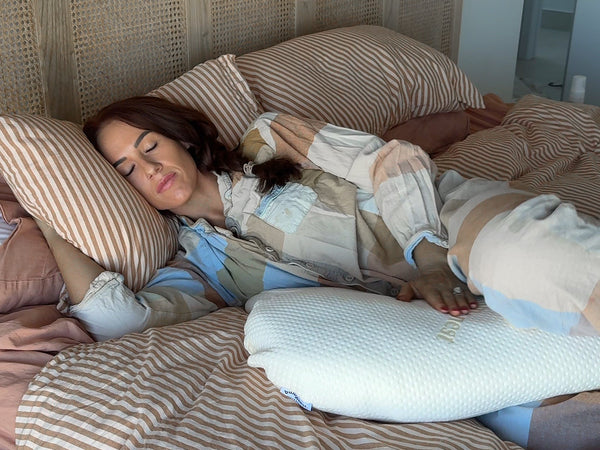 Sleep
Sleep
How to Use a Pregnancy Pillow
A pregnancy pillow only works if it's positioned correctly. Here's exactly how to set one up for ...
Read article → Sleep
Sleep
Pregnancy Insomnia: Why It Happens and What to Do
Lying awake at 2am is one of the most common pregnancy experiences nobody warns you about. Here's...
Read article →