
How to Use a Pregnancy Pillow
Knowing you need a pregnancy pillow and knowing how to use one are two different things. Here's a practical, position-by-position guide to getting the most out of yours.

Buying a pregnancy pillow is the easy part. Knowing how to use it is where most people need a little guidance. The position of each component makes a significant difference to how effective it is — a wedge in the wrong place provides almost no relief, while the same wedge correctly positioned can eliminate hip pain from the first night.
This guide covers exactly how to use a pregnancy pillow at each stage of pregnancy, for each of the main sleep problems it addresses.
The basics: what a pregnancy pillow is trying to do
Side sleeping is the recommended position from 28 weeks, but side sleeping without support creates three specific problems. Your bump pulls downward on your lower back. Your top hip drops forward, rotating your pelvis and loading your hip joints unevenly. And there is nothing behind you to prevent rolling onto your back.
A pregnancy pillow addresses each of these problems through positioning rather than bulk. Understanding the three zones that matter — under the bump, between the knees, and behind the lower back — makes the setup intuitive regardless of which type of pillow you have.
How to use a wedge pregnancy pillow
A wedge is the simplest and most targeted pregnancy pillow. It is a small triangular foam or firm cushion that can be positioned in two main ways.
Under the bump: Lie on your side and slide the wedge underneath your bump from below, so it is lifting upward rather than pressing from the side. The thick end of the wedge should face outward and the tapered end should tuck underneath. You should feel an immediate reduction in the downward pull on your lower back. Adjust the position until you feel supported rather than pushed.
Behind the lower back: Place the wedge against your lower back with the flat side against your body and the wedge angled away. This gives you something to lean against slightly and creates gentle resistance to rolling onto your back overnight.
A single wedge addresses one zone at a time. Many women use two — one under the bump and one behind the back — which covers the most important zones without the bulk of a full-body pillow.
How to use a full-body C-shaped or U-shaped pillow
Full-body pillows wrap around one or both sides of your body and address multiple zones with a single piece. The setup is more straightforward but the positioning still matters.
For a C-shaped pillow: Position the top curve of the C under your head or neck. The long front section runs along your front — your bump rests against the upper portion and your top knee rests over the lower portion. The bottom curve tucks between your knees or beneath them. The pillow does not run behind your back, which means rolling is still possible. Some women place a regular pillow or rolled blanket behind their lower back to address this.
For a U-shaped pillow: The top of the U supports your head. One arm of the U runs along your front for bump and knee support. The other arm runs along your back. Lie between the two arms of the U so you are enclosed on both sides. The advantage is that you do not need to move the whole pillow when you roll from one side to the other — you simply shift within it.
How to use a modular pregnancy pillow system
A modular system or adjustable like the Bumpnest Maternity Pillow uses three independent components rather than one large pillow. This is the setup that provides the most targeted support and takes up the least bed space, but it requires a brief explanation of where each piece goes.
Step 1 — The front bump wedge. Lie on your side in your natural sleeping position. Place the front wedge underneath your bump, lifting from below. The wider, more supportive edge should be toward your hip and the wedge should angle up to cradle the underside of your bump. You should feel your lower back relax as the downward pull reduces.
Step 2 — The knee component. Place the auxiliary piece between your knees. It should be thick enough to keep your knees genuinely hip-width apart — imagine your normal standing position. Your hips should feel stacked directly on top of each other rather than twisted. This is the adjustment that has the most immediate impact on hip pain.
Step 3 — The back wedge. Place the back wedge behind your lower back with the flat side against your body. Position it so it sits in the curve of your lower back rather than across your whole back. You should feel it as a gentle support rather than a firm push. This component is what discourages rolling onto your back overnight.
When you roll to the other side: Each component stays roughly in place because they are positioned independently rather than draped across your body. The bump wedge may need a quick reposition, but the knee and back components generally stay put. This is the main practical advantage of a modular system over a single large pillow.
Adjusting your setup for specific problems
Primarily hip pain: Prioritise the knee component above everything else. A thick, firm piece between your knees that maintains the gap through the night is the single most effective adjustment for hip pain. If you only do one thing, do this.
Primarily lower back tension: Prioritise the bump wedge. Lower back tension during pregnancy sleep is usually driven by the downward pull of the bump, and lifting from below is what addresses it. The back wedge provides secondary benefit.
Primarily rolling onto your back: Prioritise the back wedge. Position it firmly against your lower back before you fall asleep. Over several nights your body adapts to leaning against it and the rolling reduces.
Heartburn as well as physical discomfort: Elevate the head of the bed slightly in addition to using your pillow components. The bump wedge and knee component address the hip and back issues. The bed elevation addresses the heartburn. They work independently and are compatible with each other.
Pelvic girdle pain or SPD: The knee component is essential and needs to be positioned carefully. Keep your knees no wider apart than hip-width and ensure the component is firm enough to maintain that gap. Roll using the log-roll technique — keeping your shoulders, hips, and knees moving together as one unit — rather than swinging your legs across.
How setup changes across the trimesters
Second trimester (around 18 to 28 weeks): The bump is growing but not yet large. The bump wedge may only need to be partially positioned under the bump rather than fully supporting it. The knee component becomes relevant as hip discomfort builds. The back wedge is useful from the start for preventing back rolling.
Early third trimester (28 to 34 weeks): The bump wedge needs to be positioned further under the bump as it grows. The knee component becomes more critical as relaxin levels peak and hip joint laxity is at its highest. The full three-zone setup is most beneficial from this point.
Late third trimester (34 weeks to birth): Your bump is at its largest. The bump wedge may need adjusting more frequently as the shape changes. Side switching during the night requires repositioning the bump wedge each time — a quick adjustment of a few seconds rather than a full rearrangement.
Postpartum: The setup remains useful for recovery rest and feeding support. The bump wedge and knee component support hip and lower back alignment during the recovery weeks. The long body component, placed across the lap while sitting, provides a raised surface for feeding your baby that reduces arm and shoulder fatigue during long sessions.
Common mistakes and how to fix them
The pillow is between the knees but the hips are still twisted. The pillow is too thin or too soft and is compressing under your weight. You need something firmer that actually maintains the gap between your knees rather than just filling the space.
The bump wedge is against the side of the bump rather than underneath it. Reposition it so it is lifting from below. The lift is what reduces the lower back tension — sideways pressure doesn't achieve the same result.
The back wedge keeps moving away from you during the night. Position it more firmly against your back before you sleep. It should be in contact with your lower back rather than sitting a few centimetres away. Your body pressing against it during sleep is what keeps it in place.
The setup works when you first lie down but fails after the first position change. This is the limitation of regular pillows that compress and shift. A firmer, purpose-designed system holds its position better. If you're using regular pillows, replacing the knee pillow with something firmer makes the biggest difference.
Frequently asked questions
 Sleep
Sleep
Restless Legs in Pregnancy: Why It Happens and What Actually Helps
Restless legs are one of the most common and least talked about pregnancy sleep disruptions. Here...
Read article →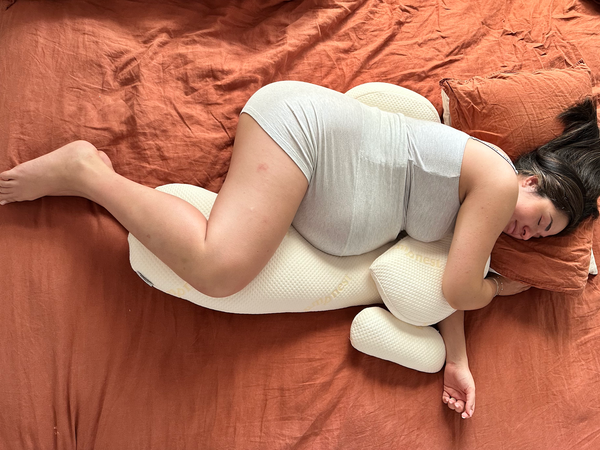 Sleep
Sleep
Pregnancy Pillow for Hip Pain: A Buyer's Guide
Waking up every hour with hip pain is one of the most disruptive pregnancy sleep experiences. The...
Read article → Sleep
Sleep
Compact Pregnancy Pillow: Why Smaller is Often Better
A full-body pregnancy pillow takes up half the bed, retains heat, and shifts when you roll. A com...
Read article →