
4 Gentle Stretches to Relieve Back Pain During Pregnancy
Back pain is one of the most common pregnancy complaints. These four stretches take less than ten minutes and can make a noticeable difference done consistently.

Back pain during pregnancy is one of those things that starts as a minor inconvenience and can quietly become one of the more disruptive parts of your day. As your bump grows, your centre of gravity shifts forward, your lower back curves more deeply to compensate, and the hormone relaxin loosens the joints and ligaments throughout your pelvis. The result is a combination of muscle tension, joint pressure, and fatigue that most pregnant women experience to some degree from the second trimester onwards.
The good news is that targeted stretching genuinely helps. These four stretches are safe during pregnancy, require no equipment, and take less than ten minutes to work through. Done consistently — even just once or twice a day — most women notice a real reduction in tension and discomfort.
As always, check with your midwife or GP before starting a new exercise routine during pregnancy, particularly if you have pelvic girdle pain, symphysis pubis dysfunction, or any complications.
1. Standing hamstring stretch
This one targets the hamstrings and lower back simultaneously, which is useful because tightness in the back of the thighs often pulls directly on the lower back and worsens the posture changes pregnancy creates.
Stand facing a sturdy surface — a kitchen bench or the back of a solid chair works well. Rest your forearms on the surface and step your feet back until your spine can soften into a gentle forward lean. From there, shift your hips backwards and let your tailbone lift slightly until you feel a stretch running down the back of your thighs and into your lower back. It should feel like a release rather than a strain.
Hold for 15 to 20 seconds, breathing steadily throughout. Repeat two to three times per side.
2. Cat-cow
Cat-cow is one of the most recommended movements for pregnancy back pain because it works the full length of the spine gently and rhythmically, improving mobility and releasing the tension that builds from carrying extra weight at the front.
Come onto your hands and knees with your wrists directly under your shoulders and your knees under your hips. On an inhale, let your belly drop towards the floor, lift your tailbone, and look gently forward — this is the cow position. On an exhale, round your spine upwards, tuck your chin towards your chest, and draw your lower belly gently inward — this is the cat position.
Move slowly and let your breath lead the movement. Five to ten rounds is enough. If your wrists are uncomfortable, folded fists or yoga blocks bring your wrists into a more neutral position.
3. Seated piriformis stretch
The piriformis is a small muscle that runs deep in the buttock, and during pregnancy it tends to tighten significantly as your pelvis shifts and widens. When it's tight, it can compress the sciatic nerve, causing the shooting or aching pain down the back of the leg that many pregnant women experience from the second trimester onwards.
Sit upright on a firm chair with both feet flat on the floor. Cross your right ankle over your left knee so your right leg forms a figure-four shape. Sit tall and lean very slightly forward from the hips — you should feel a deep stretch in the right buttock almost immediately. If you want more intensity, gently press down on the right knee.
Hold for 15 to 20 seconds, then switch sides. If this position puts any pressure on your bump or feels uncomfortable in your pelvis, skip it and mention it to your midwife.
4. Child's pose with wide knees
Child's pose is one of the most effective restorative positions for lower back tension, and adapting it for pregnancy is straightforward. The wide-knee variation creates space for your bump so there's no compression.
Kneel on the floor — a yoga mat or folded blanket under your knees adds comfort — and bring your big toes together while taking your knees wider than your hips. Sit back towards your heels and walk your hands forward along the floor, letting your torso lower between your thighs. Rest your forehead on the floor or on a folded blanket if the floor feels too far.
Hold for 20 to 30 seconds, focusing on slow, full breaths. Each exhale is an opportunity to let a little more tension release from your lower back. Come out of the pose slowly — roll to one side rather than pushing straight up.
A few notes on doing these consistently
Frequency matters more than duration. Two or three minutes of stretching done twice a day is more effective than a longer session done occasionally. Try building one round into your morning routine and one before bed when tension tends to peak.
Breathe through each stretch. Holding your breath tightens the muscles you're trying to release. Slow, full breathing — in through the nose, out through the mouth — makes every stretch more effective.
Stop if something hurts. Mild tension is normal. Sharp pain, any sensation in your pubic bone or pelvis, or pain that worsens during a stretch is a signal to stop and speak with your healthcare provider. Pelvic girdle pain in particular can be aggravated by certain positions, so if you've been diagnosed with PGP or SPD, check with your physio before trying these.
Frequently asked questions
 Wellness
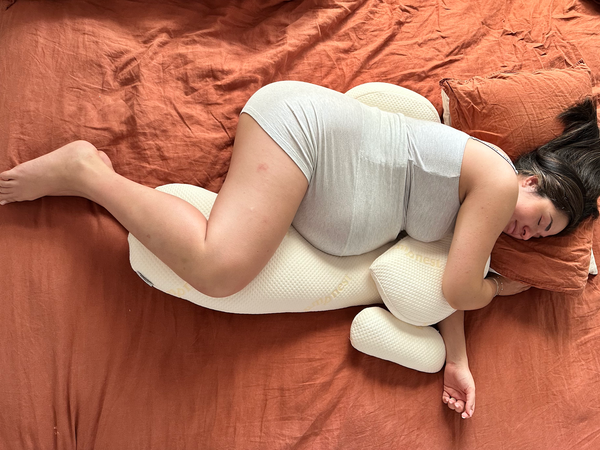
Pregnancy Pillow for Hip Pain: A Buyer's Guide
Waking up every hour with hip pain is one of the most disruptive pregnancy sleep experiences. The...
Read article → Wellness
Pregnancy Skin Changes: What to Expect and What's Normal
The linea nigra, melasma, stretch marks, acne, and itching — pregnancy skin changes are almost un...
Read article →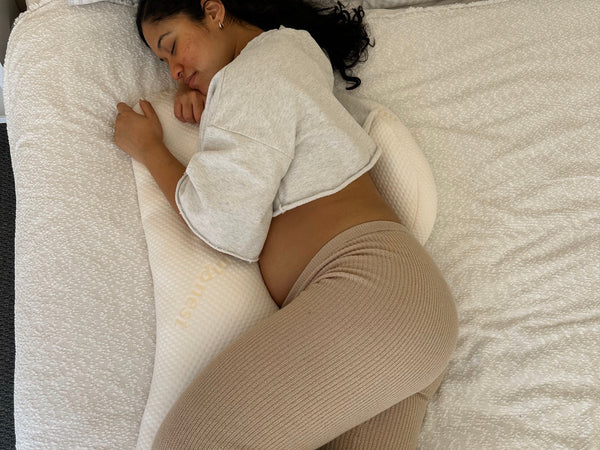 Wellness
Pregnancy Pillow for Back Pain: What Actually Works
Pregnancy back pain at night is one of the most common sleep disruptors from the second trimester...
Read article →