
The Partner-Friendly Pregnancy Pillow Guide (How to Get Support Without Taking Over the Bed)
Your body needs support. Your partner needs sleep. The bed hasn't grown. Here's how to solve all three at once.

At some point in the second trimester, a moment arrives. You've assembled a nest of four pillows, a wedge, and a body pillow that extends well past your side of the bed. Your partner is clinging to eight inches of mattress with the quiet dignity of someone who has accepted their situation but has not forgotten it.
You need support. That's not up for debate. But there's a version of pregnancy sleep support that doesn't require your partner to relocate to the sofa, and it starts with understanding what your body actually needs and what a pillow genuinely has to do.
The real problem with full-body pregnancy pillows in a shared bed
A U-shaped or large C-shaped pregnancy pillow is genuinely useful in the right context. In a king bed with a partner who sleeps heavily and runs warm, it causes very little friction. In a double or queen bed where two adults are already negotiating space, it's a different story.
The physics are straightforward. A standard U-shaped pregnancy pillow is typically 150 to 160 centimetres long and 70 to 80 centimetres wide when opened. In a queen bed measuring 153 centimetres across, that leaves your partner with somewhere between 30 and 50 centimetres of space once the pillow is in place. That's not a sleep space. That's a ledge.
Beyond the physical space, a large wraparound pillow creates a barrier that is both literal and felt. The body contact and warmth that helps many couples feel connected through the changes of pregnancy disappears behind a wall of memory foam. Partners who already feel peripheral to the pregnancy experience frequently report that this makes things worse, not better.
None of this is anyone's fault. It's just physics and feelings operating in a small space.
What your body actually needs support for
The good news is that you don't need a pillow the size of a small sofa to get what your body needs overnight. The support that makes the difference comes down to three specific zones.
Under your bump. As your pregnancy progresses, the weight of your bump creates a downward pull when you lie on your side. A small wedge positioned underneath provides lift that reduces tension across your lower back and takes pressure off the hip you're lying on.
Between your knees. This is the single most important piece of the puzzle. Without something between your knees, your top hip drops forward when you lie on your side, pulling your hip joints and lower back out of alignment. A pillow between your knees keeps your hips stacked and reduces the hip and pelvic pain that wakes most pregnant women in the early hours.
Behind your lower back. Something to lean against slightly discourages rolling onto your back and gives your body a sense of being supported without requiring you to be fully enclosed. It doesn't need to be large — a small wedge does the job.
Here's the key insight: none of these zones require a pillow that extends the full length of your body. Each can be addressed with a compact, targeted piece that stays on your side of the bed.
Why compact and targeted beats big and comprehensive
A standard body pillow or U-shaped pillow tries to address all three zones with one large object. In principle this sounds efficient. In practice, one large pillow shifts as a unit when you move, meaning the component that was supporting your bump is now across your knees and the part that was behind your back is on the floor.
Targeted support using smaller, independently positioned components solves this. Each piece stays where it's placed because it has a specific job in a specific location rather than draped across your whole body. The result is more stable support on your side of the bed and considerably more space on theirs.
The bed footprint difference is meaningful. Three compact components covering the three zones take up a fraction of the space of a single large pillow and can be arranged entirely within your natural sleeping area without crossing the midpoint of the bed.
The conversation worth having
If your partner is already a bit frayed about the pillow situation, or you're anticipating that reaction, it's worth framing the upgrade in terms of what they get out of it rather than what you need.
The actual outcome of good pregnancy sleep support is less tossing and turning. When your hips are properly aligned and your bump is supported, you move less overnight because you're not waking from pain and repositioning every hour. Less movement means fewer disturbances for the person sleeping next to you.
Better sleep for you, through the third trimester, also means you arrive at the postpartum period with more resilience. That matters to both of you.
Practical tips for keeping the bed workable
Keep your support on your side. This sounds obvious but becomes harder to enforce with large pillows that migrate. Compact, independently positioned components are easier to keep within your half of the bed.
Choose materials that breathe. Pregnancy raises your core body temperature and you're generating more heat overnight than usual. A pillow that retains heat and radiates it toward your partner is going to create friction beyond the space problem. Breathable covers make a genuine difference.
Give your partner a say. If they're already frustrated, asking them what bothers them most — the space, the barrier feeling, the heat — gives you useful information and makes them feel included in solving the problem rather than subject to it.
Accept that some nights are just hard. Even the most compact, well-designed setup doesn't fix the fact that third trimester sleep is genuinely difficult for both of you. Lower the expectations on both sides and the pressure eases.
Where the Bumpnest system fits in
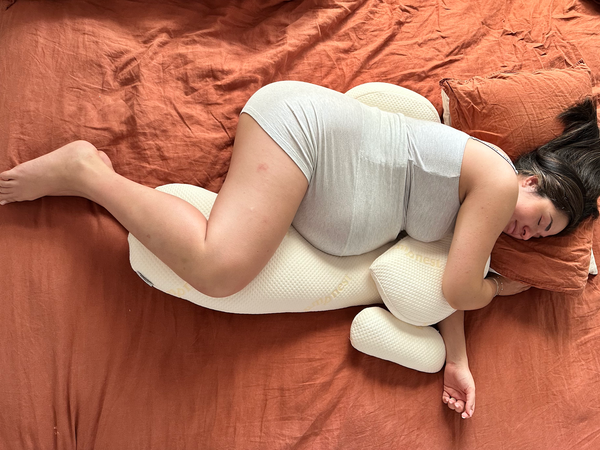
The Bumpnest Maternity Pillow was designed with this specific tension in mind. The three-component modular system provides targeted support across the three zones that matter — front wedge under the bump, back wedge behind the lower back, and the auxiliary component between the knees, without requiring one large pillow to do all three jobs from a single position.
Because each component is compact and independently positioned, the whole setup sits within your natural sleeping area rather than spreading across the bed. Partners in double and queen beds consistently report that the footprint is significantly more manageable than a U-shaped or full-body alternative.
It also means that when you roll from one side to the other overnight, you're repositioning three small pieces rather than dragging a 160-centimetre body pillow across your partner's sleeping space at 3am. That distinction matters more than it sounds after a few weeks of broken sleep.
Frequently asked questions
 Sleep
Sleep
Pregnancy Pillow for Hip Pain: A Buyer's Guide
Waking up every hour with hip pain is one of the most disruptive pregnancy sleep experiences. The...
Read article → Sleep
Sleep
Compact Pregnancy Pillow: Why Smaller is Often Better
A full-body pregnancy pillow takes up half the bed, retains heat, and shifts when you roll. A com...
Read article → Sleep
Sleep
Pregnancy Pillow for Back Pain: What Actually Works
Pregnancy back pain at night is one of the most common sleep disruptors from the second trimester...
Read article →