
Hip and Pelvic Pain at Night During Pregnancy: Why It Happens and What Actually Helps
Hip pain that wakes you up at night is one of the most common — and least talked about — pregnancy complaints. Here's what's behind it and what genuinely helps.

You roll over and feel it. That deep, sharp ache in your hip that jolts you awake and tells you sleep is over for the next hour, at least. You shift to the other side. That hip starts aching too. You lie on your back for relief and remember you're not supposed to. You stack another pillow between your knees. It slides out within minutes.
If this is your night, every night, you're not doing anything wrong. Hip and pelvic pain during pregnancy is one of the most common sleep disruptors from the second trimester onwards, and it gets progressively worse as your pregnancy advances. It also gets very little attention compared to how significantly it affects sleep and daily function.
Here's what's actually happening and what makes a real difference.
Why hip pain gets worse at night during pregnancy
Hip and pelvic pain during pregnancy has a specific physical cause that's worth understanding, because it explains why so many of the obvious fixes don't fully work.
During pregnancy, your body produces a hormone called relaxin that loosens the ligaments and joints throughout your pelvis. This is necessary — your pelvis needs to accommodate your growing baby and eventually expand for birth. But it also means your joints are less stable than usual, and that instability is felt most acutely when you're in one position for an extended period.
When you lie on your side without adequate support, two things happen simultaneously. The hip you're lying on takes the full weight of your body against the mattress, creating direct pressure on the greater trochanter — the bony prominence on the outside of your hip. And your top leg, without anything to rest on, drops forward across your body. This rotation pulls on your hip joints, your lower back, and the muscles around your pelvis. Over time, lying in this position creates the deep aching pain that wakes you up.
Night makes it worse for a straightforward reason: you've been in the same position long enough for the pressure and tension to accumulate. During the day, you're moving, shifting, and changing positions constantly. At night, you're still — and the discomfort has time to build.
Why flipping sides doesn't solve it
The instinct when one hip hurts is to roll to the other side. And it works, for a while. But if your underlying sleep position isn't properly supported, you're just moving the problem from one hip to the other. Within 20 to 40 minutes, the new hip starts to ache, and the cycle starts again.
This is sometimes called the rotisserie chicken problem — constantly rotating to distribute the discomfort rather than actually addressing what's causing it. If this is your experience, you don't need to toss and turn more efficiently. You need a different setup altogether.
What actually helps
A pillow between your knees — but positioned correctly
This is the most important single adjustment you can make, and it's worth understanding why it works. A pillow between your knees stops your top leg from dropping forward, which keeps your hips stacked rather than twisted. This removes the rotational pull on your hip joints and lower back that drives most of the pain.
The positioning matters though. The pillow needs to be thick enough to keep your knees roughly hip-width apart. A pillow that's too flat compresses quickly and stops doing its job. And it needs to stay between your knees when you roll — which is where most standard pillows fail.
Support under your bump
As your bump grows, the weight of it pulls downward when you lie on your side, creating tension across your lower back and contributing to the pelvic instability that causes pain. A wedge or small pillow tucked underneath your bump from below provides lift that counteracts this pull. Many women find this makes an immediate difference to the depth of pain they experience overnight.
Something behind your lower back
Placing support behind your lower back reduces the muscular effort your body is making to hold a side-lying position without rolling. It also takes some of the strain off your hip on the mattress side, because your weight is partially distributed backwards as well as downward.
Keep your knees together when you roll
This is standard advice from women's health physiotherapists and it's genuinely effective. When you roll from one side to the other, rolling log-style — keeping your shoulders, hips, and knees moving together rather than letting your legs lead — significantly reduces the asymmetric loading on your pelvis that causes pain spikes during position changes. It takes conscious effort at first but becomes habitual quickly.
Address the mattress
If your mattress is very firm, a mattress topper can redistribute pressure and reduce the direct impact on your hip bone. This isn't a replacement for proper positional support, but if you're already doing everything else and still waking from pressure pain specifically on the hip you're lying on, it's worth considering.
Why DIY setups often fall short
Most women try to solve this with regular pillows before anything else, and it's a reasonable starting point. The problem is that regular pillows compress and shift. You roll, the pillow moves, the alignment is lost, and you're awake repositioning at 3am. You then fall back asleep in a slightly wrong position and wake up an hour later in pain again.
The other issue is that standard pillows address one zone at a time. A pillow between the knees doesn't support the bump. A pillow under the bump doesn't stop the top hip from dropping. Getting all three zones supported simultaneously with separate pillows is possible but difficult to maintain through a night of movement.
How the Bumpnest system addresses this specifically
The Bumpnest Maternity Pillow is a modular three-piece system rather than a single body pillow. The front wedge supports under the bump, the back wedge sits behind your lower back, and the auxiliary component sits between your knees. Because each piece is positioned where it's actually needed rather than approximated by one large pillow, the support stays more consistent when you move.
For hip and pelvic pain specifically, the combination of the knee component and the front bump wedge addresses the two main drivers simultaneously — the dropping top hip and the downward pull of the bump — which is what makes the difference for women who've already tried regular pillows without enough relief.
There's a 50-night trial. If it doesn't make a genuine difference to your pain, return it.
When to see a physiotherapist
If your hip and pelvic pain is severe, persists during the day, or you're experiencing pain in your pubic bone as well as your hips, it's worth asking your GP or midwife for a referral to a women's health physiotherapist. You may be experiencing pelvic girdle pain (PGP) or symphysis pubis dysfunction (SPD), both of which are diagnosable conditions with specific management strategies beyond sleep positioning.
A physiotherapist can assess your specific presentation and give you targeted guidance on sleep positioning, movement patterns, and whether a pelvic support belt might help. The earlier you get assessed, the better — these conditions respond well to early intervention and tend to be harder to manage the longer they go unaddressed.
Frequently asked questions
 Sleep
Sleep
Pregnancy Pillow for Hip Pain: A Buyer's Guide
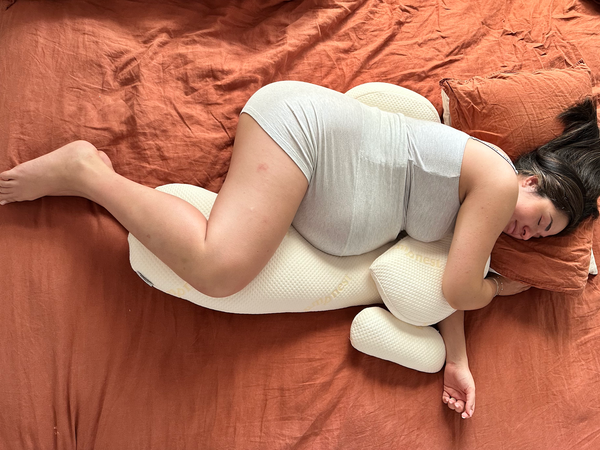
Waking up every hour with hip pain is one of the most disruptive pregnancy sleep experiences. The...
Read article →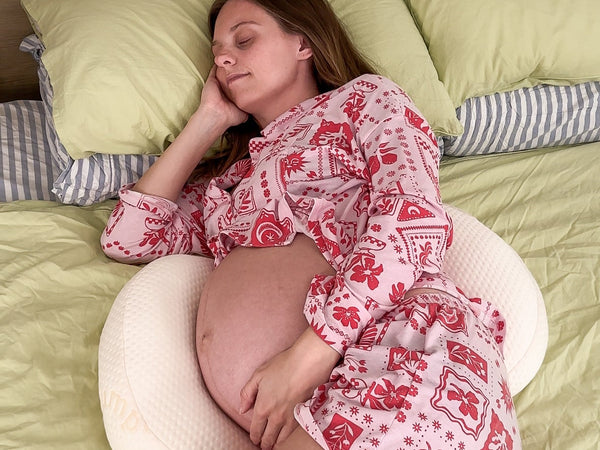 Sleep
Sleep
Compact Pregnancy Pillow: Why Smaller is Often Better
A full-body pregnancy pillow takes up half the bed, retains heat, and shifts when you roll. A com...
Read article →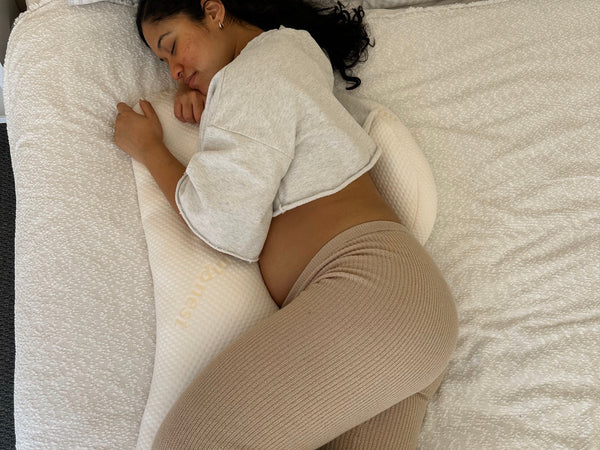 Sleep
Sleep
Pregnancy Pillow for Back Pain: What Actually Works
Pregnancy back pain at night is one of the most common sleep disruptors from the second trimester...
Read article →