
The Secret to Better Sleep During Pregnancy
Sleep during pregnancy gets harder as your bump grows. Here's what's behind it and what genuinely helps.

Sleep during pregnancy sounds like it should come easily. You're exhausted. Your body is working hard. Rest should follow naturally.
But ask any pregnant woman past the first trimester and she'll tell you a different story. The exhaustion is real, but so is the inability to get comfortable, stay asleep, or wake up feeling rested. It's one of pregnancy's more frustrating contradictions.
The good news is that poor sleep during pregnancy isn't just something to endure. Understanding why it happens makes it a lot easier to address.
Why sleep gets harder as your pregnancy progresses
In the first trimester, fatigue is usually the dominant experience — most women sleep more, not less. It's from the second trimester onwards, and particularly in the third, that sleep quality starts to deteriorate.
Several things converge at once. Your bump changes which positions are comfortable or even possible. The hormone relaxin loosens your joints and ligaments, which creates hip and pelvic pain when you lie on your side without adequate support. Heartburn becomes more common as your growing uterus puts pressure on your stomach. Frequent trips to the bathroom interrupt deep sleep cycles. And from 28 weeks, the guidance to sleep on your side — rather than your back — adds another layer of adjustment for anyone who has never been a natural side sleeper.
The result is that many women spend their third trimester exhausted but unable to get the rest they need.
Why sleep matters more during pregnancy
This isn't just about comfort. Sleep is when your body does its most intensive repair and recovery work, and during pregnancy that includes supporting your baby's growth.
Poor sleep during pregnancy has been associated with increased rates of anxiety, higher blood pressure, and longer labours. It also compounds the physical discomforts — pain feels worse, nausea lingers longer, and emotional resilience drops when you're consistently under-rested.
Prioritising sleep isn't indulgent. It's one of the more concrete things you can do for your own health and your baby's.
What actually helps
Sort out your sleep position first. From 28 weeks, NSW Health recommends settling to sleep on your side. Either side is fine — left or right. If you wake up on your back, don't panic. Simply roll back onto your side and go back to sleep. The guidance is about the position you fall asleep in, not where you end up mid-night.
Address the hip and pelvic pain. This is the most common reason side sleeping becomes unsustainable. Without support, your top hip drops forward when you lie on your side, pulling on your lower back and creating pressure on the hip that's in contact with the mattress. A pillow between your knees reduces this significantly by keeping your hips stacked rather than twisted.
Support your bump. As your pregnancy progresses, the weight of your bump creates a downward pull when you lie on your side. A wedge or small pillow underneath provides lift and reduces the tension across your lower back.
Manage heartburn at night. Eating smaller meals in the evening, avoiding lying down within an hour of eating, and slightly elevating the head of your bed can all reduce nighttime reflux. This is one of the more disruptive but underrated causes of broken sleep in the third trimester.
Keep your room cool. Pregnancy raises your core body temperature, and heat is a genuine sleep disruptor. A cooler room — around 18 to 20 degrees — makes a measurable difference for most people.
Where a maternity pillow fits in
A good setup for side sleeping requires support in three places simultaneously: under your bump, between your knees, and behind your lower back. Most people try to achieve this with regular pillows, which work until they shift — usually the first time you roll over.
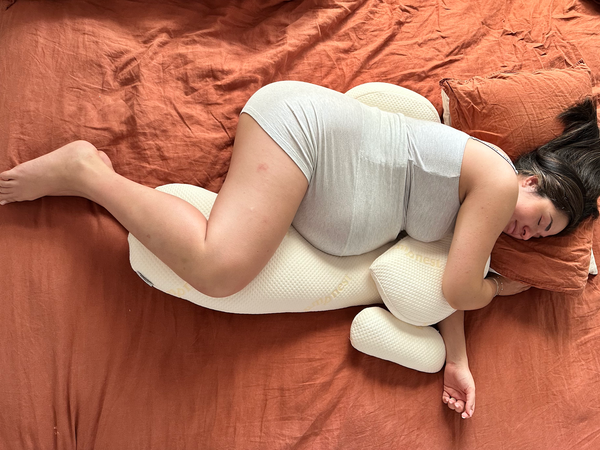
The Bumpnest Maternity Pillow is designed around this. Rather than a single large body pillow, it uses a modular three-piece system that supports each zone separately. Because the components work together rather than as one bulky shape, it stays positioned when you move and takes up considerably less of the bed than a U-shaped or C-shaped pillow.
It's worth noting: no pillow prevents you from rolling, and no pillow is a medical device. What a good system does is make the recommended sleep position comfortable enough that your body actually wants to stay there through the night.
There's a 50-night trial, so if it doesn't genuinely improve your sleep you can return it.
Frequently asked questions
 Sleep
Sleep
Pregnancy Pillow for Hip Pain: A Buyer's Guide
Waking up every hour with hip pain is one of the most disruptive pregnancy sleep experiences. The...
Read article → Sleep
Sleep
Compact Pregnancy Pillow: Why Smaller is Often Better
A full-body pregnancy pillow takes up half the bed, retains heat, and shifts when you roll. A com...
Read article → Sleep
Sleep
Pregnancy Pillow for Back Pain: What Actually Works
Pregnancy back pain at night is one of the most common sleep disruptors from the second trimester...
Read article →