
Best Sleeping Position During Pregnancy: A Complete Guide
Side sleeping is the recommended position from 28 weeks. Here's why it matters, which side is best, and how to actually make it comfortable enough to stick to.

Sleep position during pregnancy is one of those topics that attracts a lot of conflicting advice. Some sources say sleep only on your left side. Others say either side is fine. Some suggest propping yourself up. Others warn against lying flat. The result is that many pregnant women spend their nights anxious about their position on top of everything else that's already making sleep difficult.
The guidance from NSW Health is actually quite straightforward, and understanding the reasoning behind it makes it considerably easier to follow without anxiety. Here's what you need to know.
The recommendation: side sleeping from 28 weeks
NSW Health recommends that from 28 weeks of pregnancy, women settle to sleep on their side for every sleep episode. This includes going to sleep at night, returning to sleep after waking during the night, and daytime naps.
The recommendation applies from 28 weeks because this is when the uterus becomes large enough that lying on your back can put significant pressure on the inferior vena cava, the large vein that returns blood from the lower body to the heart. This pressure can reduce blood flow and oxygen delivery to the uterus and placenta. Research has found that women who consistently go to sleep on their back in the third trimester have a higher risk of late stillbirth compared to those who go to sleep on their side.
The key phrase is going to sleep. The research concern is about the position you fall asleep in, not the position you find yourself in during the night. If you wake up on your back, simply roll back onto your side and go back to sleep. Your body will generally alert you before circulation is significantly affected.
Left side or right side: does it matter?
This is one of the most common questions about pregnancy sleep position and the answer, according to NSW Health, is that either side appears equally safe.
You may have heard that the left side is preferable because it keeps the uterus off the inferior vena cava more completely and may slightly improve blood flow to the kidneys and placenta. There is some evidence for a minor circulatory benefit of left-side sleeping. However the current Australian guidance is clear that both sides are acceptable. Right-side sleeping is not harmful.
The most practical approach is to sleep on whichever side is more comfortable. If you spend half the night on your left and half on your right, that is entirely appropriate. If your right hip is less painful than your left, sleep on your right. The goal is consistent side sleeping, not exclusively left-side sleeping.
What about the first and second trimesters?
In the first trimester, sleep in whatever position is comfortable. Your uterus is still small enough that lying on your back does not create the circulatory concerns that apply in the third trimester. Many women find that first trimester nausea and fatigue mean they sleep whenever and however they can, which is entirely fine.
In the second trimester, from around 18 to 20 weeks, your bump is beginning to grow in ways that make some positions less comfortable. Lying on your stomach becomes increasingly impractical as the bump grows. Lying on your back may start to feel heavy or cause mild dizziness in some women as the uterus puts early pressure on the vena cava.
The second trimester is the ideal time to start practising and adapting to side sleeping if you haven't been a natural side sleeper. Starting at 20 weeks rather than waiting until 28 weeks means your body has time to adjust to the position before it becomes the mandatory recommendation. By the time the third trimester arrives, side sleeping already feels natural rather than forced.
Why side sleeping feels uncomfortable without support
Knowing you should sleep on your side and being able to sleep on your side comfortably are two different things. Most women who struggle with side sleeping in pregnancy are not doing anything wrong — they're simply lying in a position that requires support their setup isn't providing.
When you lie on your side without adequate support, three things happen simultaneously. The weight of your bump pulls downward, creating tension across your lower back. Your top hip drops forward under gravity, rotating your pelvis and loading your hip joints unevenly. And you have nothing behind you to lean against, which means your muscles are doing sustained work to maintain the position throughout the night.
The result is hip pain that wakes you within forty to sixty minutes, lower back stiffness by morning, and a constant need to reposition that fragments sleep throughout the night.
None of this is inevitable. It's a function of the setup rather than the position itself.
How to make side sleeping comfortable: the three-zone setup
Comfortable side sleeping in pregnancy requires support in three specific areas simultaneously. Each zone addresses a different driver of discomfort and all three need to be covered to make side sleeping genuinely sustainable.
Under your bump. A wedge or small pillow positioned underneath your bump from below provides lift that counteracts the downward pull of pregnancy weight. This reduces the torsional tension across your lower back that builds through the night and is one of the most immediately noticeable improvements most women experience.
Between your knees. This is the single most important adjustment for hip pain. A pillow thick enough to keep your knees genuinely hip-width apart stops your top hip from dropping forward, which keeps your pelvis in a stacked, neutral position rather than a rotated one. The pillow needs to hold its shape through the night — most standard pillows compress too quickly to do this reliably.
Behind your lower back. Something behind your lower back serves two purposes. It reduces the muscular effort required to maintain side lying, which reduces the fatigue that builds through the night. And it gently discourages rolling onto your back, which addresses the NSW Health guidance without requiring you to consciously maintain your position throughout the night.
When all three zones are supported, the position stops fighting you and your body can actually rest.
The Bumpnest Maternity Pillow is a modular three-piece system designed specifically around these three zones. Rather than one large body pillow that approximates support across your whole body, each component addresses one zone independently — front wedge under the bump, auxiliary piece between the knees, back wedge behind the lower back. Because each piece is positioned precisely where it needs to be, it stays in place when you roll rather than shifting out of position, which is the main reason women who've tried regular pillow arrangements find it more effective.
See the Bumpnest Maternity Pillow →
What about sleeping on your back?
The recommendation is to avoid going to sleep on your back from 28 weeks, but waking up on your back is not cause for alarm. Simply roll back onto your side.
Research published in EClinicalMedicine, which informed Australian safe sleep guidance, found that the risk is associated with the sustained period of back sleeping that occurs when you fall asleep in that position and remain there. Rolling there incidentally during the night involves much shorter durations in the supine position, and your body's own discomfort signals generally prevent extended back sleeping in the third trimester anyway.
If you find yourself consistently rolling onto your back and this is causing you anxiety, the back wedge component of a proper pregnancy pillow setup addresses it practically. Having something to lean against makes your body less likely to roll fully supine during the night.
Sleeping semi-reclined: when it helps and when it doesn't
Some women find that sleeping in a semi-reclined position, slightly propped up rather than fully horizontal, helps with heartburn and shortness of breath in the third trimester. This can be achieved by elevating the head of the bed, using a firm wedge under the upper body, or sleeping in a recliner chair.
Semi-reclined sleeping can be compatible with the side-sleeping recommendation if you are oriented on your side rather than on your back. A fully reclined position on your back, even at an angle, still puts some pressure on the vena cava and is not an equivalent to side sleeping.
If heartburn is a specific issue affecting your sleep, elevating the head of the bed slightly while still sleeping on your side addresses both concerns simultaneously.
The log-roll: the movement that protects you when changing position
Every time you change position during the night, the way you move matters. Swinging your legs across independently creates asymmetric rotational force through your pelvis that causes the sharp pain spikes that fully wake you, particularly in the third trimester when pelvic joints are loosened by relaxin.
The log-roll technique keeps your shoulders, hips, and knees moving together as one unit. Before rolling, engage your pelvic floor gently, bring your knees together, and rotate your whole body rather than leading with your legs. It feels deliberate initially and becomes automatic within a few nights.
This is the most consistently recommended movement modification from women's health physiotherapists for overnight pain management, and it costs nothing and requires no equipment.
Building the habit before you need it
The best time to adapt to side sleeping is before the third trimester, when the recommendation becomes more pressing and when sleep deprivation has already been building for weeks. Women who start practising consistent side sleeping in the second trimester, around 18 to 22 weeks, find the transition to the position much less disruptive than those who try to change everything at once at 28 weeks.
Starting earlier also means you have time to find a pillow setup that works before you need it urgently. Getting your three-zone support right at 22 weeks is considerably easier than figuring it out at 35 weeks when every night of poor sleep matters more.
Frequently asked questions
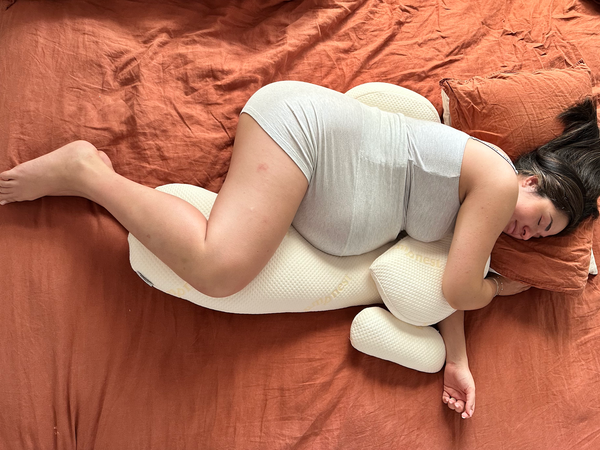 Sleep
Sleep
Pregnancy Pillow for Hip Pain: A Buyer's Guide
Waking up every hour with hip pain is one of the most disruptive pregnancy sleep experiences. The...
Read article →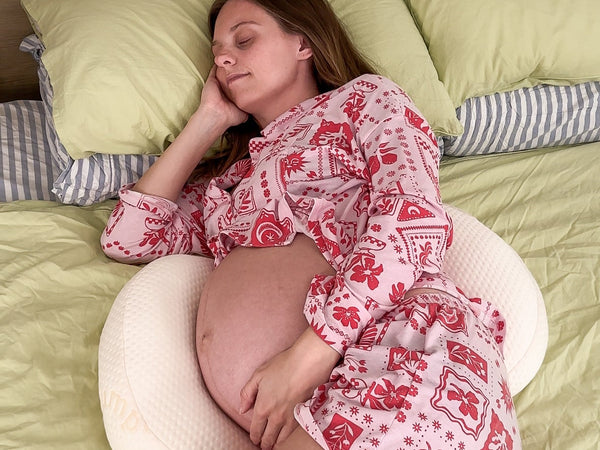 Sleep
Sleep
Compact Pregnancy Pillow: Why Smaller is Often Better
A full-body pregnancy pillow takes up half the bed, retains heat, and shifts when you roll. A com...
Read article →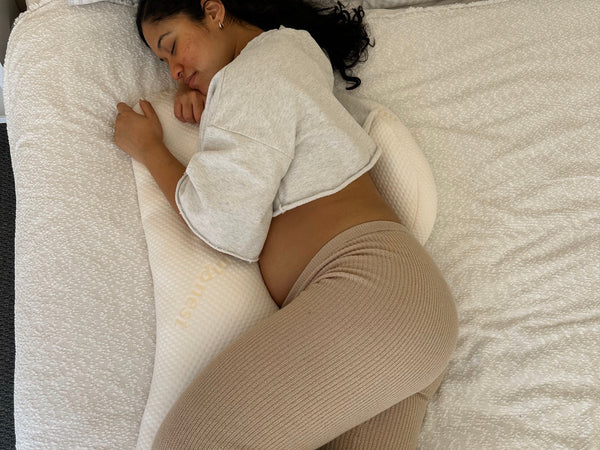 Sleep
Sleep
Pregnancy Pillow for Back Pain: What Actually Works
Pregnancy back pain at night is one of the most common sleep disruptors from the second trimester...
Read article →