
Third Trimester Sleep Survival Guide
Week 35. You've tried every pillow combination. You've done the stretches. You still can't get comfortable. This guide is for you.

Week 35. You're exhausted in a way that doesn't respond to rest. The hip you're lying on aches within forty minutes. Rolling over wakes you fully. Heartburn arrives the moment you lie flat. The bathroom trip at 2am takes fifteen minutes to recover from because getting back to sleep requires renegotiating your entire pillow arrangement. And your baby, apparently unbothered by all of this, is performing their most active routine of the day at 3am.
This is third trimester sleep. It is genuinely hard, it affects the majority of pregnant women to a significant degree, and "just rest when you can" is not a useful response when the barriers to rest are this specific and this physical.
This guide covers what actually works — the sleep position mechanics, the pillow setup, the non-pillow changes, and the mindset shift that makes the worst nights more manageable. Not everything will work for every person. But the combination of strategies here covers the main drivers of third trimester sleep disruption, and addressing them systematically produces better outcomes than trying things randomly.
Why third trimester sleep is harder than earlier trimesters
Third trimester sleep disruption has multiple overlapping causes that compound each other. Understanding what's driving your specific experience helps you target the right solutions rather than trying everything at once.
The bump limits your positions. By the third trimester, sleeping on your back is not recommended — NSW Health advises settling to sleep on your side from 28 weeks, as lying flat puts pressure on the major blood vessels running behind the uterus. Sleeping on your stomach is physically impossible. Side sleeping is what remains, and side sleeping without adequate support becomes increasingly painful as the bump grows.
Hip and pelvic pain wakes you. When you lie on your side without support, your top hip drops forward, creating rotational tension through your hip joints and lower back. The pressure on the hip you're lying on builds over forty to sixty minutes until it wakes you. You roll to the other side. That hip starts building. The cycle repeats. This is the most common driver of overnight waking in the third trimester and the one most directly addressable with the right setup.
Heartburn intensifies at night. Your growing uterus puts upward pressure on your stomach, and the hormone progesterone relaxes the valve that normally prevents stomach acid from rising. Lying horizontal removes the gravitational advantage you have during the day. The result is heartburn that starts when you lie down and builds through the night.
Bathroom trips are unavoidable. Your bladder has significantly less capacity than usual as your baby's head puts pressure on it. Most third trimester women make one to three bathroom trips per night, and each one is a full awakening that requires resettling from scratch.
Braxton Hicks and fetal movement. Practice contractions are more frequent in the third trimester and fetal movement peaks in the evening and overnight. Neither is harmful, but both are disruptive to deep sleep.
Your mind is busy. The approaching birth, the unfinished preparation, the anxiety about parenthood — the third trimester brings a particular mental load that doesn't always switch off when your body needs it to.
Sleep position: getting the mechanics right
The most impactful change you can make to third trimester sleep is getting your side-sleeping setup right. This sounds basic but most women are sleeping with inadequate support in one or more of the three zones that matter.
Zone 1: Under your bump. As your bump grows, its weight creates a downward pull when you lie on your side — your bump drops toward the mattress while your spine stays in place, creating torsional tension across your lower back. A wedge or pillow positioned underneath your bump from below provides lift that counteracts this pull. The relief is often immediate. Without it, your lower back muscles are doing sustained work throughout the night to compensate, which is part of why you wake feeling worse than when you lay down.
Zone 2: Between your knees. This is the single most important adjustment for hip pain. Without support between your knees, your top leg drops forward under gravity, rotating your pelvis and loading the hip joints asymmetrically. The pillow between your knees needs to be thick enough to keep your knees genuinely hip-width apart — not just resting between them but actually maintaining the gap. Most regular pillows compress too quickly to do this reliably through the night.
Zone 3: Behind your lower back. Something behind your lower back serves two purposes. It discourages rolling onto your back, which addresses the NSW Health guidance without requiring you to consciously maintain position through the night. And it gives your back something to lean against slightly, which reduces the muscular effort of maintaining a side-lying position and takes some of the compression off the hip you're lying on.
All three zones need to be addressed simultaneously. Supporting only your knees without your bump, or only your bump without your knees, leaves the main pain drivers in place. This is why stacking regular pillows often doesn't fully solve the problem — they address one zone at a time and shift during the night.
The Bumpnest Maternity Pillow is a modular three-piece system designed specifically for this. Rather than one large body pillow that approximates support across your whole body, each component addresses one zone independently — front wedge under the bump, auxiliary component between the knees, back wedge behind the lower back. Because each piece is positioned exactly where it needs to be, it stays in place when you roll rather than dragging with you, which is the main reason women who've tried regular pillow stacks find it more effective.
If you're waking multiple times overnight from hip pain, or repositioning your pillows more than once per night, this is the stage where getting the setup right makes the biggest difference.
See the Bumpnest Maternity Pillow →
Managing heartburn overnight
Heartburn is one of the most disruptive and underrated sleep disruptors in the third trimester. The good news is that it responds well to a combination of dietary timing and physical positioning.
Eat earlier and lighter in the evening. Your last meal of the day should be your smallest and should ideally finish at least two hours before you lie down. A large meal sitting in a stomach that has less room than usual, followed immediately by lying flat, is the most reliable way to guarantee overnight reflux. A small snack is fine if you're hungry close to bedtime — something with protein and low acid content rather than anything fatty, spicy, or tomato-based.
Elevate the head of your bed. Raising the head of your bed by even five to ten centimetres uses gravity to keep stomach acid down. You can do this by placing books or bed risers under the head-end legs of your bed, or by using a firm wedge pillow to raise your upper body. This is one of the most consistently effective interventions for pregnancy heartburn that doesn't involve medication.
Avoid lying on your right side if heartburn is a specific issue. The stomach sits slightly to the left of your midline, meaning lying on your right side can allow stomach acid to pool at the valve between the stomach and oesophagus. Lying on your left side keeps the stomach positioned below the valve for most people. If your heartburn is consistently worse on your right side, experimenting with left-side preference is worth trying.
Speak with your GP or midwife about safe antacids. Several antacid medications are considered safe during pregnancy and can make overnight heartburn manageable when dietary changes alone are insufficient. This is not something to simply endure when treatment is available.
Managing bathroom trips
You cannot eliminate overnight urination in the third trimester, but you can reduce the frequency and manage the resettling process.
Front-load your fluids. Drink the majority of your daily fluid intake before 5pm and taper off significantly in the two hours before bed. You still need to stay well hydrated overall — around 2.3 litres per day during pregnancy — but the timing makes a real difference to overnight frequency. A glass of water with dinner rather than a litre of water at 9pm is the practical version of this.
Empty your bladder fully before bed. Sit rather than hovering, lean slightly forward, and take your time. This sounds obvious but many people don't empty fully and feel the need to return within thirty minutes.
Have everything you need within reach before you go to sleep. If getting up requires navigating obstacles, turning on lights, or spending more than a minute or two, you'll be more awake than you need to be. A bedside lamp on low rather than an overhead light, a clear path to the bathroom, and your phone face-down to avoid light stimulation all reduce the arousal impact of each trip.
Non-pillow changes that make a real difference
Keep your room cool. Pregnancy raises your core body temperature and makes you more sensitive to heat during sleep. The ideal sleep temperature is around 18 to 20 degrees Celsius — cooler than most people keep their bedrooms. A fan, lightweight bedding, and keeping the window open when possible all help. This is one of the more underappreciated sleep improvements in the third trimester.
Magnesium for restless legs and cramps. Restless leg syndrome and leg cramps are common in the third trimester and are often linked to magnesium levels. Magnesium supplementation has reasonable evidence for reducing both. Speak with your midwife or GP before starting, but it's worth raising at your next appointment if these are affecting your sleep.
A wind-down routine that actually works. Your nervous system needs a transition between the demands of the day and sleep. This matters more in the third trimester when the mental load is highest and the physical discomfort makes it harder to switch off. A consistent pre-sleep routine — the same activities in the same order, finishing at the same time — becomes a sleep cue over time. It doesn't need to be elaborate: a warm shower, some gentle stretching, and thirty minutes without screens is enough.
Stop timing your sleep. Watching the clock at 2am calculating how many hours you have left before you have to be up is one of the most effective ways to prevent sleep from returning. If you wake during the night, turn your phone face-down or put it out of reach. The anxiety about not sleeping is often more disruptive than the waking itself.
The log-roll: the movement change worth making
Every time you change position in the third trimester — and you'll do it multiple times a night — the way you move matters. Leading with your legs creates asymmetric rotational force through your pelvis that causes the sharp pain spikes that fully wake you.
The log-roll technique keeps your shoulders, hips, and knees moving together as one unit. Before rolling, engage your pelvic floor gently, bring your knees together, and rotate your whole body rather than swinging your legs. It feels deliberate initially. Within a few nights it becomes automatic and the pain associated with position changes reduces significantly.
This is the most recommended movement modification from women's health physiotherapists for hip and pelvic pain at night, and it costs nothing and takes no equipment.
Getting in and out of bed
This is the movement that causes the most pain spikes in the third trimester and happens more often than you'd like given the bathroom visits.
Getting up: Roll onto your side using the log-roll. Bring your knees together and lower them toward the edge of the bed. Use your top arm to push yourself up to sitting rather than using your abdominal muscles. Stand slowly, keeping your feet hip-width apart.
Getting into bed: Sit on the edge of the bed first. Lower yourself to one side using your arm, swinging both legs onto the bed simultaneously. Roll to your preferred side using the log-roll.
When some nights are just awful
Some third trimester nights are genuinely awful regardless of what you do. The baby moves constantly, nothing feels comfortable, and sleep simply doesn't arrive. No pillow system, no dietary adjustment, no technique makes those nights good.
What matters in those moments is removing the secondary suffering — the anxiety about not sleeping, the calculation of how tired you'll be tomorrow, the catastrophising about labour on no rest. Sleep in fragments is still physiologically useful. Lying still with your eyes closed has rest value even without sleep. This phase is temporary, even when it doesn't feel like it.
Be honest with your care team about how your sleep is affecting you. Severe sleep deprivation in the third trimester is worth discussing at your next appointment rather than simply enduring.
Frequently asked questions
 Sleep
Sleep
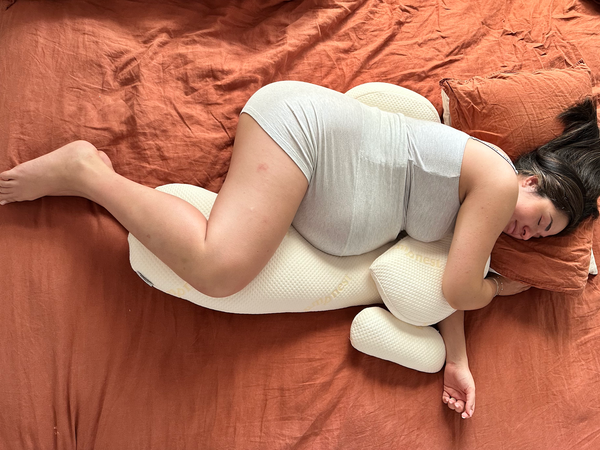
Pregnancy Pillow for Hip Pain: A Buyer's Guide
Waking up every hour with hip pain is one of the most disruptive pregnancy sleep experiences. The...
Read article →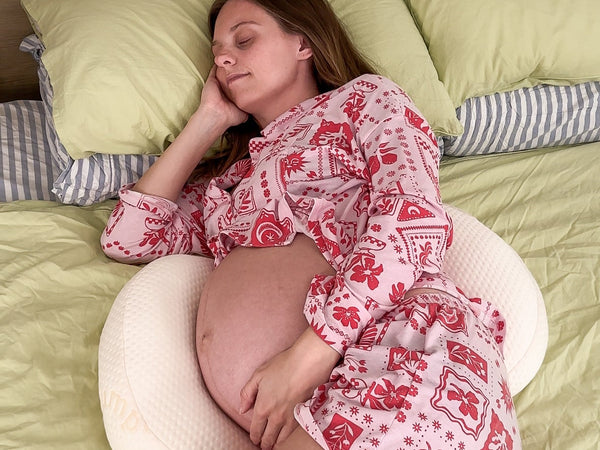 Sleep
Sleep
Compact Pregnancy Pillow: Why Smaller is Often Better
A full-body pregnancy pillow takes up half the bed, retains heat, and shifts when you roll. A com...
Read article →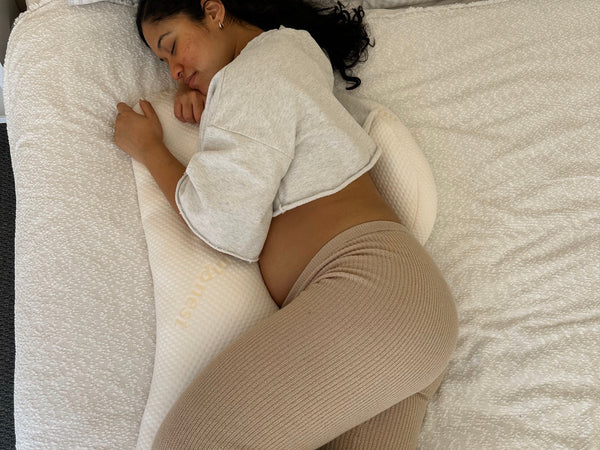 Sleep
Sleep
Pregnancy Pillow for Back Pain: What Actually Works
Pregnancy back pain at night is one of the most common sleep disruptors from the second trimester...
Read article →